Friday, 10 May 2013

Facebook's censorship hypocrisy

Facebook's censorship policies have been in the news again recently. This latest row is the result of several videos of people being decapitated. These are (somehow) not in violation of Facebook's community standards, and the site resisted initial pressure to have them removed, only caving when the media started reporting on the story. Their initial reasoning for leaving the video online was that it was being shared in the spirit of condemnation of the actions depicted in the video, and that Facebook respects "people's rights to describe, depict and comment on the world in which we live". While this statement makes a great soundbite for the site, it is clearly shown to be false when considering how the site enforces its existing censorship policies.

My main beef here is that there seems to be a world of difference in the strictness of the policy when applied to different types of content. Let's look at those community standards again. The guide on hate speech acknowledges a distinction between serious and humorous speech, allowing purveyors of "bad taste" jokes a platform while (theoretically) filtering out the worst excesses of hate groups. In practice however, the distinction between serious and humorous speech is not so easily made, especially over the Internet where a person's intended meaning can easily be misinterpreted by others. In this instance Facebook seems to err on the side of leniency when filtering content, and rightly so - while jokes about dead babies may be grossly offensive to many people, this alone is not reason enough to instigate a policy of censorship. Facebook's policy on phishing and spam is taken equally lightly - to be honest, I was surprised to find this included in their community standards at all. While I find unsolicited spam annoying, I can understand why it's there - Facebook is a business, and the first priority of any business is to make a profit, so fair play.

One of their community standards which is taken seriously is "nudity and pornography". The rule here seems to be no nipples (if female), and nothing in the crotch area, though pretty much anything else goes. (It's worth noting that Facebook makes a specific exemption for breastfeeding photos.) This is probably what gets me the most about the lopsidedness of their censorship policy. The argument most often brought up in the interests of censorship (apart from the "offense" point, which I don't respect enough to consider an argument) is that Facebook's minimum age limit is 13, meaning potentially anyone of this age with a Facebook account can access anything posted on Facebook. What I don't understand here is how nipples are more damaging to a child's development than videos of decapitation or extreme violence; though the decapitation videos have been removed, there's plenty of other violent content on the site (don't worry, that link doesn't point to them). To understand my problem here, take a look at these pictures:


It took a surprisingly long time to find a photo of Femen that didn't include swearing.

The one on the left is copied directly from Facebook, and is a fairly vanilla example. The one on the right I had to source from Google images and is apparently too extreme for Facebook. That particular photo is taken from a French news site and is hardly pornographic in nature (unless you're really missing the point). Now consider our hypothetical 13-year-old again. A lot of children would be upset by the image of a dead animal - could the same really be said of boobs? Most of us are, after all, exposed to boobs from an early age. That's not to say that Facebook should start allowing hardcore pornography on its site, especially in the absence of any kind of age-verification wall, but to ban images such as the above on the same grounds is just silly.

I think the root cause here is what is considered appropriate varies from country to country, and Facebook is very much an American creation. America has always been somewhat lenient concerning depictions of violence in the media, but much less so when it comes to anything sexual. I have no idea why, perhaps something to do with the country's Christian roots, but that's the way it's always been. However, a (supposedly) international and modern institution like Facebook can and should be more mature about these things. Did I mention Femen have a Facebook group? They have to censor all their own photos to stop Facebook taking them down.

My point here is that Facebook needs to have a serious rethink about their censorship policy, and what they consider to be okay for their website. Certainly, when images such as that Femen protest photo need to be censored they can't claim to respect depictions of "the world in which we live" without reeking of rank hypocrisy. Jeremie Zimmerman makes an excellent point in the article I referenced earlier - "Since Facebook collects and stores so much information it should be able to determine when one of its members is a minor and is about to be exposed to content that has been reported as unsuitable, and display a warning message". I would go one step further - if a user is a minor in their country (let's not forget that different countries have different definitions of this), they should be barred from seeing certain content. This reduces the amount of censorship needed on the site while protecting children from age-inappropriate content. While debate may rage on exactly what this entails, a simple "mature content" flag on photos or videos such as the ones discussed in this blog would suffice to quell the criticism of Facebook almost entirely. Moreover, the more content Facebook hosts, the more options they have for making money from it. One can only wonder why they haven't implemented a system like this already.

Thursday, 25 April 2013

Iron Man 3, and what I thought of it.

I'm going to spell this out just in case the title didn't give it away, but THIS ARTICLE CONTAINS SPOILERS ABOUT IRON MAN 3!

Obligatory warning out of the way, what did I think of the film? Honestly, I was a little disappointed. I'll get on to why in a minute, but I'll start with a roundup of the things I liked about it. In no particular order:

Ben Kingsley as the Mandarin
Guy Pearce as Aldrich Killian, the Mandarin's corporate backer
Robert Downey Jr as himself
Gwyneth Paltrow kicking ass!
Some badass action sequences
Tony Stark dealing with anxiety attacks in the wake of the events of the Avengers
ALL OF THE ARMOUR!

There were a few things that really got to me about the film though, and not just the fact that AC/DC weren't heard for the duration (I mean, even Avengers used them to play in Iron Man). I'm going to start with Ben Kingsley as the Mandarin, and this is where the first MAJOR SPOILER comes in. If you haven't got the hint by now, you're never going to, so here goes.

I went to the film expecting to see the Mandarin as someone who could face off against Iron Man, or at least outwit him, but the big reveal of the film was that Ben Kingsley's character was just some drunk actor hired by Guy Pearce to play "The Mandarin" in order to cover up some malfunctioning Extremis tech and instigate a war on terror for profit. Words cannot express how gutted I was by this, but I'm going to try. I grew up watching the Iron Man cartoons on TV. This was my first experience of the character (I never really read comics as a kid), and his main nemesis in the cartoons was The Mandarin, a supervillain possessed of ten magical rings that together gave him the power to do pretty much whatever the hell he wanted. He was a total badass, but usually tended to use his intellect against Iron Man rather than tackling him head on. It made the show great to watch. So, when I heard they were bringing in the Mandarin as the villain for Iron Man 3 I got very excited. I never expected them to go down the full-on magic rings route, but I did think the Mandarin would be the central villain of the film, and I did expect him to be more than a match for Stark. For this reason, the big reveal of the film, where the Mandarin enters in his underwear to the sound of a toilet flushing and proceeds to be cowed into submission by Stark brandishing a gun, was almost painful to watch. I was expecting almost the whole way through the film for the Mandarin to reveal he'd just been playing Stark by putting on a fake British accent, and that he'd been two steps ahead of our hero all along. That's the Mandarin I remember - a genuinely threatening character, not some washed-up actor. The other reason this really disappoints me is that this means we will most likely never see the Mandarin in the Marvel movie universe.

Another big source of disappointment for me was the way the film ended. Stark blows up all his suits, gets the girl, fixes everything (including the shrapnel in his heart) and delivers a cosy little monologue about how his life is all better now and how he's a changed man. The tone is very much that he's hanging up his armour for good. If Iron Man was a separate franchise from the rest of the Marvel movieverse that's probably how they would have left the ending, and the film would have been better for it, but then they had to throw in the final line, "I am Iron Man". It just didn't fit with the rest of Stark's closing speech, and felt very much like it had been tacked on the end to leave the way open for Avengers 2. While I love watching the Marvel films, I think they were trying too hard to mimic the superhero trilogy masterclass illustrated by Christopher Nolan's Batman films, forgetting that at the end of that trilogy the hero bows out gracefully. While in real life, anyone in that position would doubtless pack it in after all that he's been through, Iron Man was never meant to have the gritty realism of the Dark Knight films - Tony Stark is too much larger-than-life, especially when Downey Jr's playing him.

And then there was the therapy - the post-credits sequence that revealed that Stark's narration of the film was actually him offloading to his lab buddy Bruce Banner, showing that the entire film was just an extended flashback. While I can understand that even Stark might have decided to get a little therapy after his anxiety attacks, a better way to show this would have been to show him talking to a character we haven't seen before. Especially in a post-credits sequence, they should be starting to drop hints about the next Avengers movie. Even if they decide not to go through with whatever they allude to, a subtle character placement would have kept the fans talking for months. Instead all we have is that Banner's going a bit grey and seems to have put on weight. The sequence was a huge missed opportunity.

Overall, I felt the film spent too much time looking back (as trilogy final-parters are prone to do) and too little time looking forward (as intermediate installments in film series are supposed to do). The music was just slightly wrong (because there was no AC/DC), Stark's suit never worked properly and I'm going to be pissed at Marvel for some time over what they did to the Mandarin.

I know a few people so far who've seen the film and loved it. I get why - there were a lot of good things about it - but for my money it could have been so much better.

Tuesday, 29 May 2012

How to survive exam season, volume 1: staying awake LIKE A BOSS.

Well, it's revision time again, which means I'm doing anything and everything I can think of to put off actually getting any work done. It also means I'm spending my entire life on campus at the moment, and my typical diet looks something like this:

The banana is important - it means this is healthy.

When I'm not turning myself into a highly caffeinated human pot noodle, I'm in the library poring through equations and derivations and trying my damndest not to fall asleep. There are various tips for this on the Internet, most of which revolve around the consumption of some form of stimulant(s). This is no exception, but I think I've hit on something good and I want to share it with you, because it gives me an extra fifteen minutes of denial about how few of my notes make any kind of sense to me.

My secret is this:
What we have here ladies and gentlemen is essentially a frappuccino and yes, this has been a convoluted build up to another student recipe blog. So here goes.

You will need:
Coffee
Sugar (vanilla sugar if you're feeling decadent)
Milk
Ice
Water
A kettle

Step 1: Boil the water. You won't need much, just fill the kettle up to the "minimum" mark so you don't damage it.
Step 2: Put the coffee and sugar into some kind of container. I use a measuring jug because it's easy to decant into the bottle. I usually use a teaspoon and a half of coffee and two teaspoons of sugar, depending on how violently I want to be woken up.
Step 3: Add just enough boiling water to dissolve the coffee and sugar.
Step 4: Add the ice to cool the boiling hot sludge you've just made.
Step 6: Pour into a bottle, or whatever you usually use to smuggle drinks into the library.
Step 7: Top up with milk. Shake well before drinking.

This tastes nicest when it's been chilled, but if you don't have a fridge you can take to the library, you can always just freeze a bit of water in the bottom of the bottle overnight to keep it cool. This stuff got me through a 40-hour day last week, though I was too wired to really think straight by the end of it. It's good for waking you up in the morning though - give it a try!

Here endeth the lesson and here beginneth the revision. Wish me luck!

Disclaimer: I am not responsible for any accident, injury or mental incapacity sustained as a result of following any advice I may or may not give or have given on this blog or anywhere else. If you decide eight teaspoons of coffee in one of these is a good idea I will not be held responsible for the consequences, but please do leave a comment letting me know what they are - I'd love to hear about it!

Wednesday, 29 February 2012

Simply Brilliant, Sallis Benney Theatre, Brighton, February 22

Hello again, and welcome to my third and final review from the Brighton Science Festival 2012. This event was again a departure from the previous two, being aimed squarely at a younger audience. Of course, I was hooked the minute I saw Lego, but I'll save that for the actual review. So, without further ado, here goes:

The first thing that struck me when I entered the Sallis Benney Theatre for Simply Brilliant was a life-sized Dalek welcoming people with threats of extermination. That set the tone very well for the rest of the evening - Simply Brilliant was very much a family affair, aimed primarily at interesting the younger generation in science.

The main focus of the evening was a number of stalls set up in the theatre space. My first stop was Sussex University's own stall, where a couple of members of the Physics department were demonstrating spectrographs. Along with a name-that-spectrum competition, they were also giving out Blue Peter-style instructions for building your own (surprisingly effective) spectrograph from a cardboard tube and a CD.

Other stalls ranged from a demonstration of a 3D printer, to a competition to see who could build the most stable tower out of Lego (I got trounced by a couple of 12-year-olds, much to my inner child's chagrin), to a stall run by some Varndean College students armed with glue guns, demonstrating recycling by gluing together parts from old broken toys to make new ones. Through the course of the evening, I couldn't help but keep coming back to this one as it slowly evolved into something resembling Sid's bedroom from Toy Story.

Brighton Science Festival curator Dr Richard Robinson had his own stall as well - a collection of old toys, with an invitation for people to come and guess how their inner mechanisms worked. Dr Robinson seemed to be having as much fun with this as anyone else, revelling in the opportunity to indulge a lifelong habit of curiosity.

The evening was punctuated with a series of talks, the first of which was given by inventor Trevor Bayliss, probably best known for inventing the wind-up radio. Following Bayliss was Sussex Visiting Research Fellow Dr Jonathan Hare, who has done extensive research in the field of Fullerene science as well as being involved with TV programmes such as Tomorrow's World and Hollywood Science with Robert Llewellyn. The third and final talk of the evening was from Brighton University Physics professor Alison Bruce, a researcher with Brighton's nuclear structure physics group.

My final impressions of the evening as I prepared to leave were that while the talks had been intellectually nourishing, it was my childish curiosity which was most satisfied by the stalls in the main theatre. This was confirmed on my way out, as out of the corner of my eye I spotted one stall in the lobby I had missed on the way in. Sitting proudly atop a table was Robot Wars UK veteran Bigger Brother, practically a celebrity from my youth. I enjoyed the evening immensely, and would recommend it when it hopefully returns next year. I would suggest visiting as a group though, as the opportunity to pit your Lego-building skills against your friends is just too good to miss.

Monday, 20 February 2012

Festival of the Spoken Nerd, The Blind Tiger, Brighton, February 19

It's another review! This time I went to see an honest-to-God standup show in a pub, which definitely ranks pretty high on my list of awesome ways to spend an evening. To make it even better the three standups were all massive nerds, as were the audience. But more on that in a minute. Incidentally, if you click on the title of this entry, and you should, it'll take you to their website.

The show inspired me to design a T-shirt, seen in my previous blog post, or here if you're really lazy. Please do leave a comment and let me know what you think. And comment on the review too, because you're a wonderful person and your opinion is really important to me :)

Buttered up yet? Good, let's get cracking!

For those of you who love to spend your evenings discussing scientific theory over a pint down the pub (come on, you know you're out there), Festival of the Spoken Nerd will be familiar territory. Run by three comedians with impressive nerd credentials, the pi-themed show, subtitled "Pi-curious", managed to present some serious mathematics in a way that was simple and understandable, even for those without any dedicated scientific training.

The evening took the form of a series of skits by the three scientists/comedians Matt Parker, Helen Arney and Steve Mould, and opened with "stand-up mathematician" Parker's attempt at setting the unofficial world record for solving a Rubik's cube while reciting world records for solving the Rubik's cube. What seems from description to be a rather dry premise was transformed on stage by Parker's excellent delivery and impressive multitasking into something truly hilarious.

Following Parker was Helen Arney, introduced as "Britain's foremost musical female physicist", with a love song written to woo that mathematician in your life. If pun-based humour is your thing, Arney and her electric ukulele have it covered, and she returned to the stage later on in the show with an audience-participation piece aimed at illustrating some of the more staggering numbers one encounters in the maths world.

Physicist Steve Mould leads a double life as the science expert for Blue Peter, and was introduced on stage as "the man who makes the technology work", just as the projection screen flashed up the infamous "blue screen of death", which anyone who was using a Windows PC a few years ago will be all too familiar with. Mould's segments of the show included "here's one I made earlier" models of solids of constant width, which defy description but are definitely worth looking up online, and he later teamed up with Parker for a comedic debate about which scientific constant was better, pi or tau.

Between them, the three kept the sell-out crowd entertained for the better part of two hours, even dragging several members of the audience up on stage to help explain the maths behind Russian Roulette, which they played with a plate of marshmallows and that stuff your parents use to stop you biting your nails. The result when Mould finally picked the loaded marshmallow was well worth waiting for!

All in all, Festival of the Spoken Nerd was an evening very well spent. It was refreshing to see a science-themed show which trusted its audience to "get it" and didn't fall into the usual trap of being overly patronising. With regular shows in London, and the promise of a return to Brighton for the comedy festival in October, there will be plenty of chances to see them in action this year and I cannot recommend them enough.

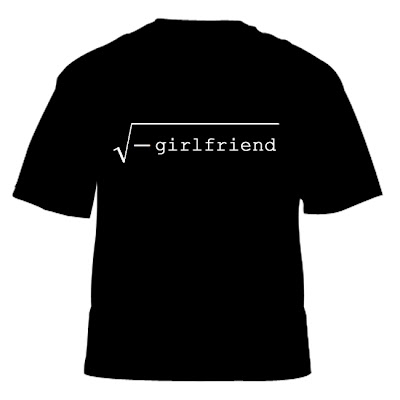
I designed a T-shirt!

Last night I went to see a very funny scientific stand-up show (yes, that's a thing) called Festival of the Spoken Nerd. I was there to write my second review from the Brighton Science Festival (coming soon to a blog... well, here), and while I was there I was inspired to design this T-shirt. So here it is:

Please leave your thoughts in the comments, but only as long as they're nice :)

Wednesday, 15 February 2012

Marcus Brigstocke: God Collar, Sallis Benney Theatre, Brighton, February 10

I've been asked by the Badger (Sussex Uni's student newspaper) to write a few reviews on events during the Brighton Science Festival. I've never written a review of anything before (aside from maybe sticking a few pithy lines about some film I've seen into a blog post), so please bear with me if I completely fuck it up. Hopefully the next few will be better. Let's crack on...

If you're anything like me, you see the words "[comedian] explores religion" and expect an evening of Bible-bashing, picking out the most insane beliefs of global religions for us all to have a good laugh at and feel smugly superior in our lack of faith. How wrong I was. God Collar, written following a long period of depression and introspection following the death of Brigstocke's best friend, is an honest exploration of faith, our need for it, and what it offers us in times of crisis.

Brigstocke deliberately focuses on the Abrahamic faiths (Christianity, Judaism and Islam) as they are the ones to which his audience, and Brigstocke himself, can most easily relate. With the curator of the Brighton Science Festival, Dr Richard Robinson, providing a sounding board and occasional prompt, Brigstocke invites his audience to join him on his exploration of faith, challenging our preconceptions both of faith and of atheism. Neither are safe from Brigstocke's unique brand of dry wit, and he firmly believes that neither should be, pointing out that fervent atheism of the kind displayed by Richard Dawkins and his contemporaries requires just as much faith in an idea as any religious belief.

The show is funny, but also thought-provoking and at times quite poignant. Brigstocke shares himself completely with his audience, drawing them in and inviting them to rethink their views on faith and what they really believe. He is keen to point out to an audience of mostly scientific minds that atheism by no means proves you are smarter than anyone else. Indeed, he makes a point of saying that some of the most stupid and vacuous people he knows are atheists.

If he makes one point to take home though, it is that faith, in whatever form, can be an immense comfort in times of crisis and should not be dismissed lightly. Even if you do not believe in the Abrahamic God (and he sees little enough reason to), it can be enough just to believe in something, and the most important thing is to keep an open mind.